
RBA Raises Rates to 4.35% — How to Budget for It and Forecast the Impact
The Reserve Bank has hiked the cash rate for the third time this year. Here's a step-by-step guide to adjusting your budget and using scenario analysis to see exactly what it means for your financial future.
Today the Reserve Bank of Australia lifted the cash rate by 0.25 percentage points to 4.35% — its third increase in 2026. With headline inflation at 4.6% and geopolitical uncertainty pushing fuel prices higher, the RBA is walking a tightrope between taming prices and tipping the economy into recession.
For households, the message is clear: budgets are about to get tighter. If you have a variable-rate mortgage, your repayments are going up. If you're saving for a house deposit or paying down debt, your timeline just shifted.
The good news? You don't have to guess the impact. With Wealthra's budgeting tools and scenario analysis, you can see exactly what this rate rise means for your finances — and plan accordingly.
What today's rate rise means for you
The cash rate has now risen from 3.85% at the start of 2026 to 4.35%. Markets are pricing in the possibility of at least one more 0.25% increase, potentially taking the cash rate to 4.70%.
Macquarie Bank has already announced it will pass the full increase on to borrowers. The big four are expected to follow within days.
How rising rates affect your money
A 0.25% rise might sound small, but it compounds across your entire financial picture.
Higher mortgage repayments
A 0.25% rise on a $485K mortgage adds roughly $85/month to your repayments.
Better savings returns
Higher rates mean your savings and offset accounts earn more — if your bank passes it on.
Tighter household budgets
With inflation at 4.6% and rates at 4.35%, discretionary spending is squeezed from both sides.
Slower asset growth
Higher borrowing costs can weigh on property and share valuations in the short term.
Changed debt payoff timelines
More of each repayment goes to interest, slowing your principal reduction.
Goal timelines shift
Savings goals for a house deposit or holiday may take longer if your surplus shrinks.
Step 1: Update your budget for the new repayment
The first thing to do is figure out how much more you'll actually be paying. Let's walk through a realistic example.
Meet Sarah. She's 34, lives in Sydney, and has a $485,000 variable-rate mortgage with about 24 years remaining. She earns $125,000 per year and has a monthly take-home of about $7,900 after tax and super.
Before today's rate rise
- Mortgage rate: 5.99% (cash rate 4.10% + 1.89% margin)
- Monthly repayment: $3,127
- Monthly surplus after expenses: $970
After today's rate rise
- Mortgage rate: 6.24% (cash rate 4.35% + 1.89% margin)
- Monthly repayment: $3,212
- Monthly surplus after expenses: $885
That's $85 more per month — or $1,020 per year — going straight to interest. Sarah's monthly surplus just shrank by 9%.
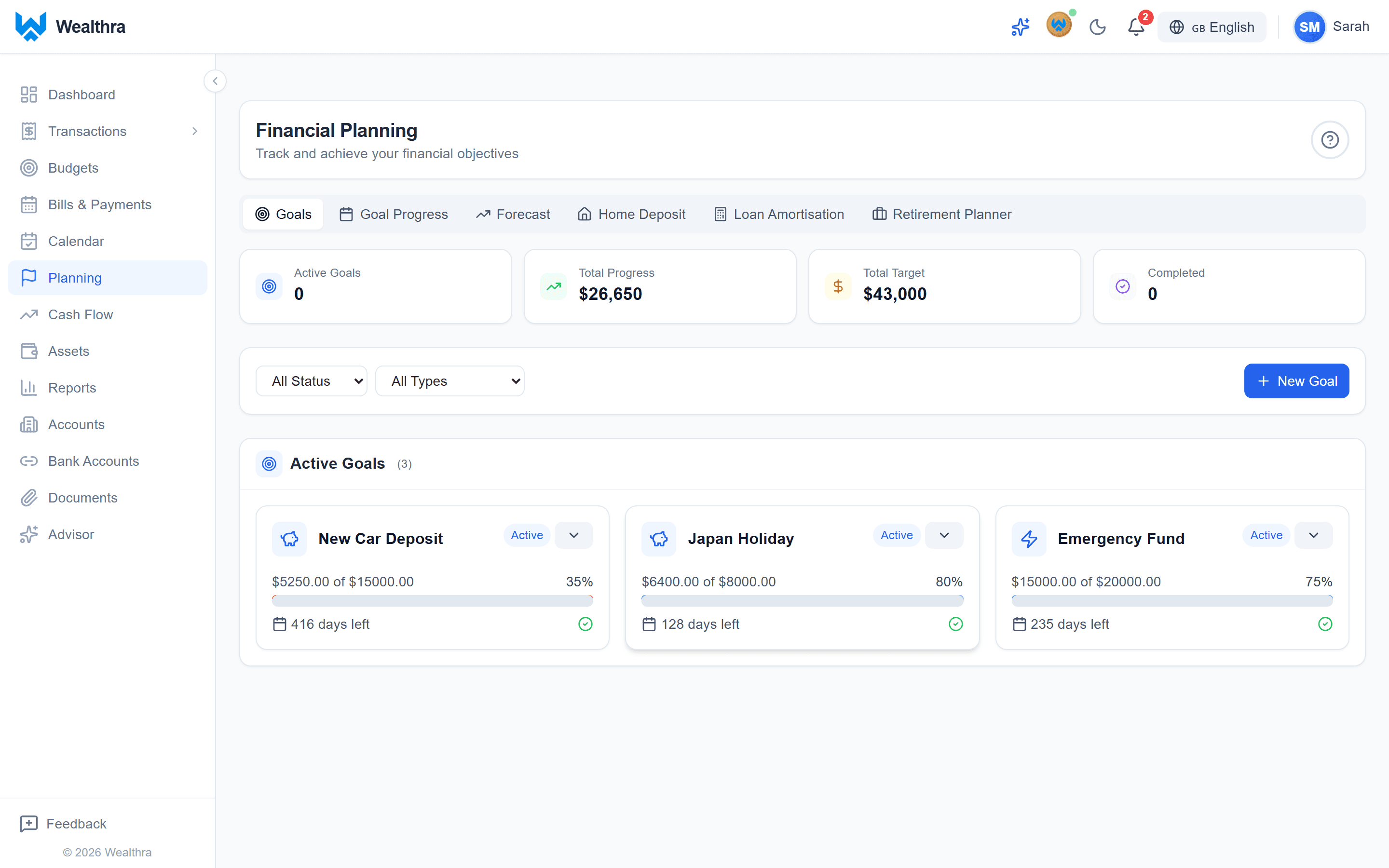
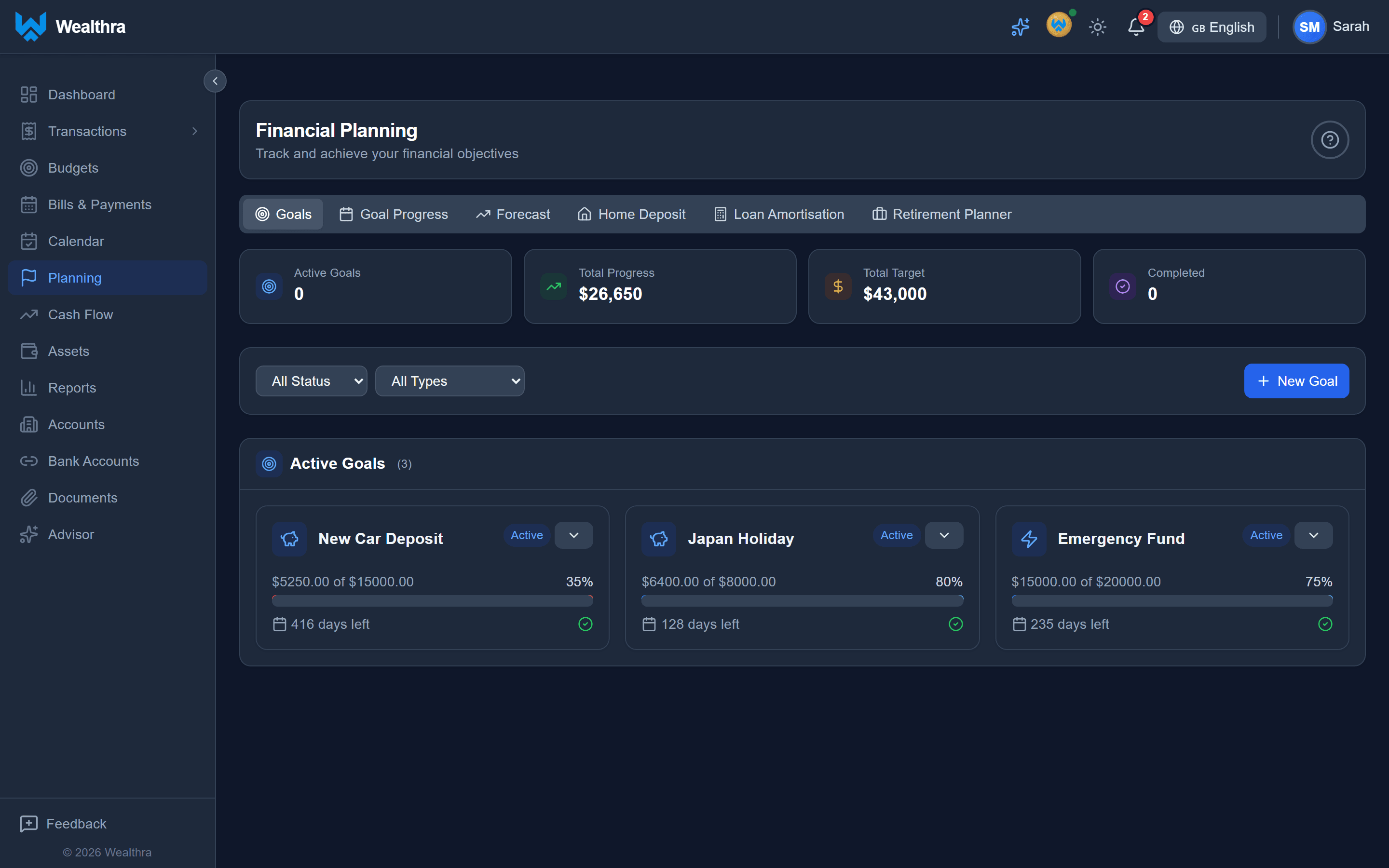
Here's how Sarah updates her budget in Wealthra:
- Go to Budgets and find the Mortgage / Housing category
- Increase the budget amount from $3,127 to $3,212
- Review other categories to find $85 to reallocate — dining out, subscriptions, or entertainment are common candidates
- Check the budget overview to confirm you're still in surplus (not deficit)
If your bank has already adjusted the repayment and you've connected your account via Open Banking, Wealthra will pick up the new amount automatically in your transaction feed. You'll see it flagged in your spending insights.
Step 2: Run a scenario analysis to see the bigger picture
Adjusting your budget tells you what this month looks like. But what about the next 12 months? Or the next five years? This is where Wealthra's Scenario Analysis feature becomes essential.
Here's exactly how Sarah would use it:
Creating an interest rate scenario
- Go to Net Worth → Forecast
- Click “New Scenario”
- Choose “Interest Rate Change” as the scenario type
- Enter the new rate: 6.24% (or just the cash rate increase of +0.25%)
- Select which liabilities are affected — in Sarah's case, her variable-rate mortgage
- Set the forecast horizon — 12 months for a short-term view, or up to 30 years for the full mortgage life
- Click “Run Scenario”
Wealthra instantly recalculates Sarah's net worth projection with the new rate applied. She can see:
- How much more she'll pay in interest over the forecast period
- How her mortgage balance payoff timeline changes
- How her overall net worth trajectory shifts
Comparing multiple scenarios side by side
The RBA has signalled that further increases are possible. Markets are pricing in a potential peak of 4.70%. Sarah can model this too:
- Create a second scenario: “If rates hit 4.70%” (mortgage rate 6.59%)
- Go to Multi-Scenario Comparison
- Select her baseline forecast, the 6.24% scenario, and the 6.59% scenario
- View them side by side on the same chart
Sarah's scenario comparison
$485K mortgage, ~24 years remaining, $125K salary. Figures are illustrative.
| Scenario | Monthly repayment | Total interest (life of loan) | Net worth in 12 months |
|---|---|---|---|
| Previous rate (5.99%) | $3,127 | $453K | $698K |
| New rate (6.24%)Today | $3,212 | $479K | $690K |
| If rates hit 4.70% (6.59%) | $3,342 | $518K | $678K |
Figures are illustrative based on a principal-and-interest variable loan. Actual repayments depend on your lender's margin and repayment structure.
The difference between the old rate and today's rate is $8,000 less net worth over 12 months. If rates climb to 4.70%, that gap widens to $20,000. These aren't abstract numbers — they're your retirement savings, your house deposit timeline, your emergency buffer.
Step 3: Adjust your goals and fight back
Seeing the impact is only useful if you act on it. Here's what Sarah decides to do after reviewing her scenarios:
- Cut $85 from discretionary spending — she reduces her dining out budget from $400 to $330 and cancels a $15/month streaming service she barely uses
- Run an extra debt payment scenario — she models putting an extra $100/month into her mortgage offset account, which saves $28K in interest over the life of the loan
- Update her emergency fund goal — with higher repayments, her target for 3 months of expenses rises from $20,000 to $20,300
- Set a rate alert — she'll revisit her scenarios when the RBA next meets in June
Why guessing isn't good enough anymore
Before today's decision, the RBA acknowledged the cash rate was near the top of the so-called “neutral rate” — one which neither stimulates nor restrains the economy. At 4.35%, the Reserve Bank has its foot firmly planted on the economic brake pedal.
Under the RBA's baseline scenario, economic growth is expected to bottom out at 1.3% annually, with unemployment climbing to 4.7%. Under its adverse scenario — where geopolitical tensions persist — growth could fall below 0.5%, raising a real risk of recession.
In this environment, “she'll be right” isn't a financial strategy. You need to know your numbers: what you earn, what you spend, what you owe, and where it's all heading.
Three things to do right now
- Check your mortgage rate. Call your bank or check your online banking. If they haven't passed on the increase yet, they will within days.
- Update your budget. Increase your housing costs and find savings elsewhere. Even $20 a week adds up to over $1,000 a year.
- Run a scenario. Open Wealthra, go to Net Worth → Forecast → New Scenario → Interest Rate Change. See the impact in black and white. Then decide what to do about it.
You can't control what the RBA does. But you can control how prepared you are for whatever comes next.
See what rising rates mean for your net worth
Connect your accounts, run a scenario, and know exactly where you stand — in under five minutes.
Get Started Free